Tashkent Travel Guide: Best Things to Do in Uzbekistan’s Capital
Unlike historic Bukhara and Samarkand, Tashkent presents itself as a much more modern and bustling city in Uzbekistan, largely because a lot of it was destroyed in an earthquake in 1966 and rebuilt. It was a nice break from all the Silk Road history and azure Timurid architecture, and also where I ended up spending my birthday! Here’s my guide on things to do in Tashkent, from checking out its historic metro stations to eating a whole lot of plov!
Tashkent was the third and last stop of my 10 days in Uzbekistan, which started off with a few interesting days in Turkmenistan and some day trips to neighbouring Tajikistan cities of Panjakent and Khujand. While we flew into Ashgabat, Turkmenistan, we flew back to Singapore from Tashkent.
Read my independent travel tips for Uzbekistan and see more of my time in Bukhara as well as guide to exploring Samarkand.
- Why visit Tashkent?
- Ride the Tashkent Metro: See Uzbekistan’s Stunning Soviet-Era Stations
- Explore Chorsu Bazaar: The Best Market in Tashkent
- Dinner at Beshqozon: Eat Plov, Uzbekistan's National Rice Dish
- Visit Hazrati Imam Complex: Hints of Tashkent’s Heritage
- Watch a Performance at the Alisher Navoi Theatre
- Stroll Tashkent City Mall: Modern City Conveniences
- Tashkent Day Trip: Tour the Uzbekistan Solar Furnace in Parkent
- Where to stay in Tashkent: Hotel 1946
Why visit Tashkent?
Tashkent has a very different vibe as compared to Bukhara and Samarkand which have retained more of its historical monuments. While Tashkent was also a prominent city along the Silk Road back in the day, a massive earthquake in 1966 destroyed a lot of the old buildings here. Tashkent was a major city under USSR rule and was rebuilt quite extensively, and today as the capital and business centre of Uzbekistan, Tashkent does have a more modern metropolis vibe.
Tashkent is also the home to the main international airport for Uzbekistan, so if you’re flying into Uzbekistan from overseas, this is likely where you will start and/or end your journey from.
I spent 4 days in Tashkent at the end of my trip before heading back to Singapore. Here’s what I did in Tashkent:
Ride the Tashkent Metro: See Uzbekistan’s Stunning Soviet-Era Stations
Tashkent is the only city in Uzbekistan to have its own metro line! Opened in 1977, it was built while under Soviet rule after the earthquake as part of the city’s rebuilding and modernisation. Today there are about 50 stations spread across 4 metro lines.
The Metro might be quite an everyday mode of transportation for city folk, but Soviet-style subways are tourist attractions in their own right because they built them very fancy. I remember touring the metro when in Moscow back in the day, and in Tashkent, each of the stations has their own design and it’s worth hopping around the various lines to check them out.
We spent an afternoon hopping on and off the train along different lines. I’m not going to show you every single station we stopped at or passed through, but these ones are some of my favourite highlights worth spending more time in.
Also, taking the metro in Tashkent is ridiculously easy and affordable. Like Singapore you can just tap your contactless card or smart phone wallet to enter and exit the gantries, and it costs just 1,700 UZS per ride – that’s 20 cents in Singapore?! Even if you bought a physical ticket, that would cost you 3,000 UZS or about 30 cents.
Up till 2018, you weren’t allowed to photograph Taskhent’s metro stations because they were used for defence purposes, but now you can take as many pix as you want. You will probably still see some security presence on the platforms, but nothing too overt.
Kosmonavtlar Metro Station: Tashkent’s Famous Space-Themed Stop
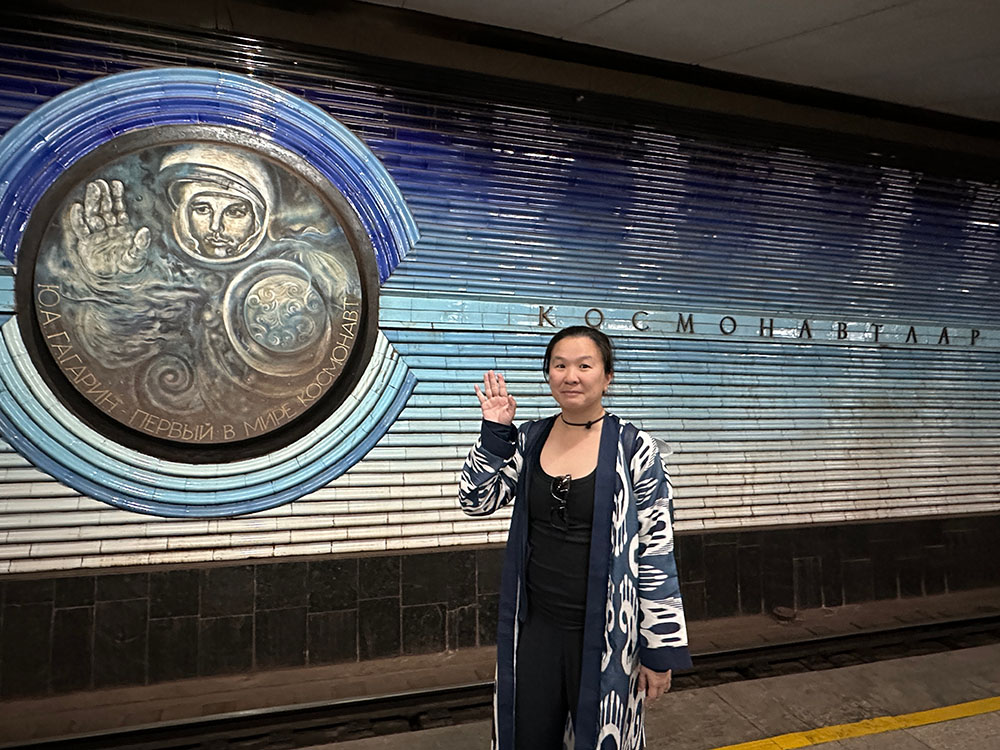
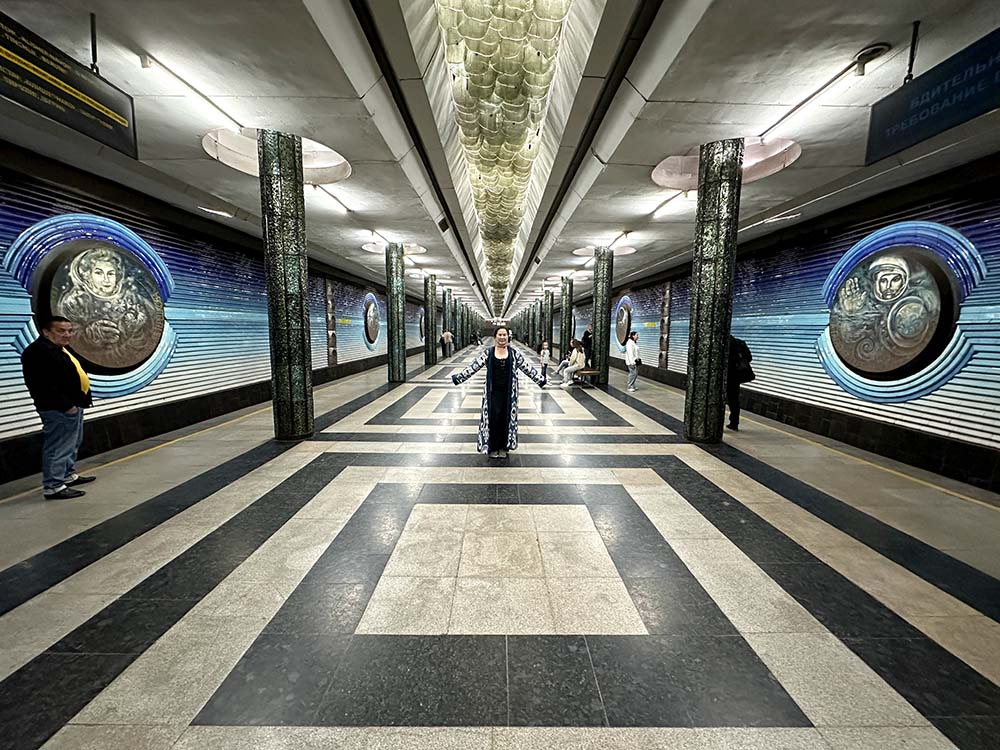
The most interesting station on the Tashkent metro has to be Kosmonavtlar Station on the blue Oʻzbekiston Line. Kosmonavtlar or ‘Cosmonaut’ honours the Soviet space programme and famous cosmonauts like Yuri Gagarin and Sputnik. The ever-present Ulugh Beg also gets a feature here.
The station’s design has a lovely blue gradient and lots of portrait panels with the various cosmonauts names and photos in them. The station’s pillars are a deep almost alien-esque green mineral texture as well, giving it a rather unworldly look, along with the star/Milky Way like light fixtures on the ceiling. This station is definitely worth a visit – the blue line does have a number of very pretty stations.
Beruniy Metro Station: Chandeliers and Symmetry
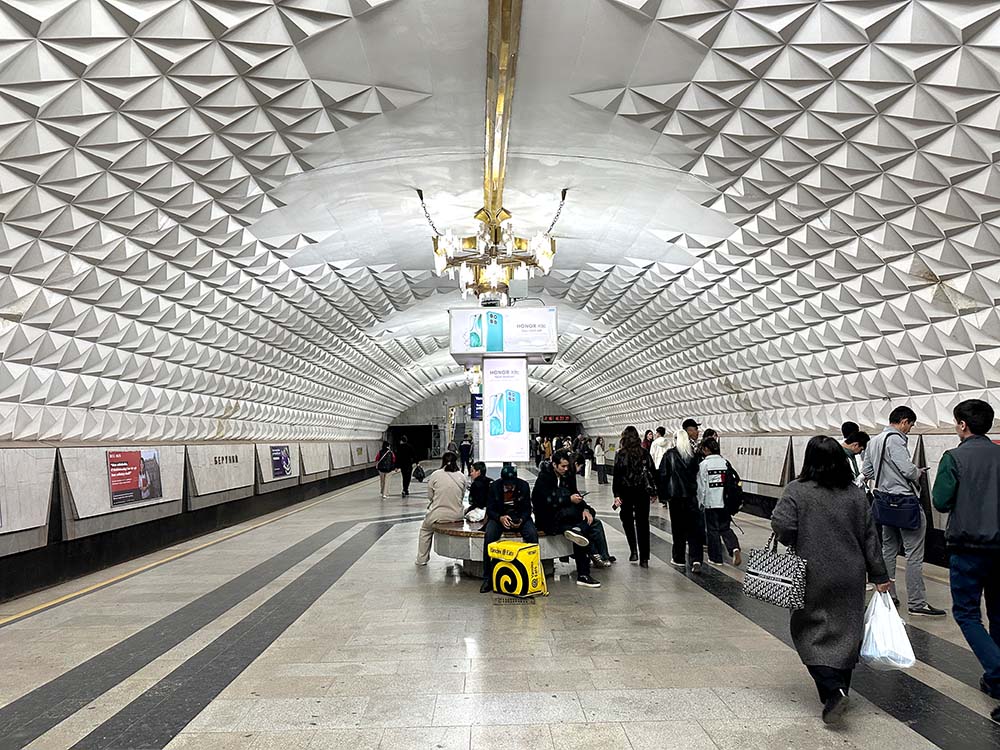
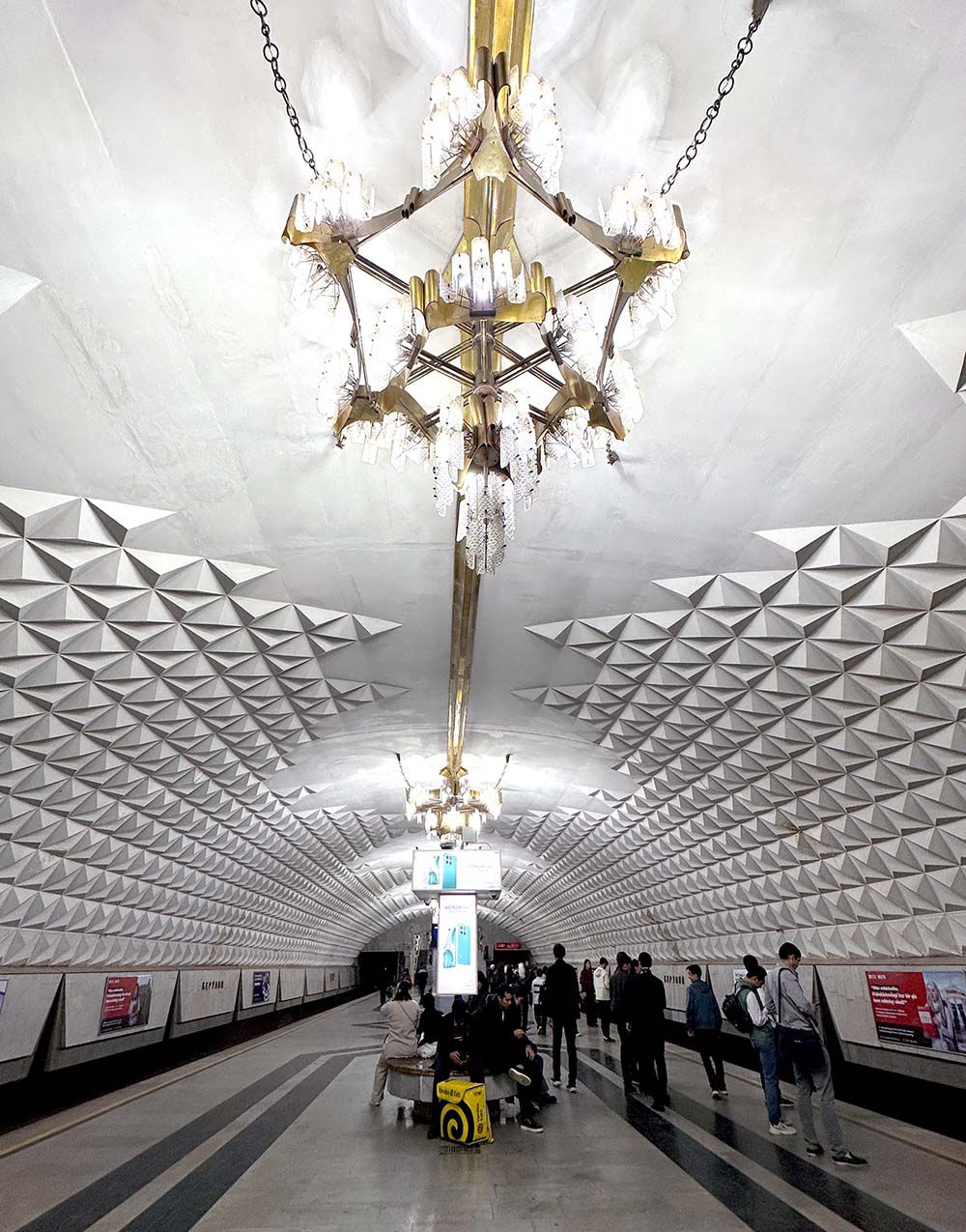
At the end of the blue Oʻzbekiston Lien is Beruniy, newer compared to Kosmosnavtlar (1991 vs 1984) and grand in its own way with a super geometric white ceiling and hanging crystal chandeliers down the platform. It’s a very striking view and feels a bit like you’re in a modern theatre.
Beruniy is named for Abu Rayhon Beruniy, an early thinker, scholar and astronomer.
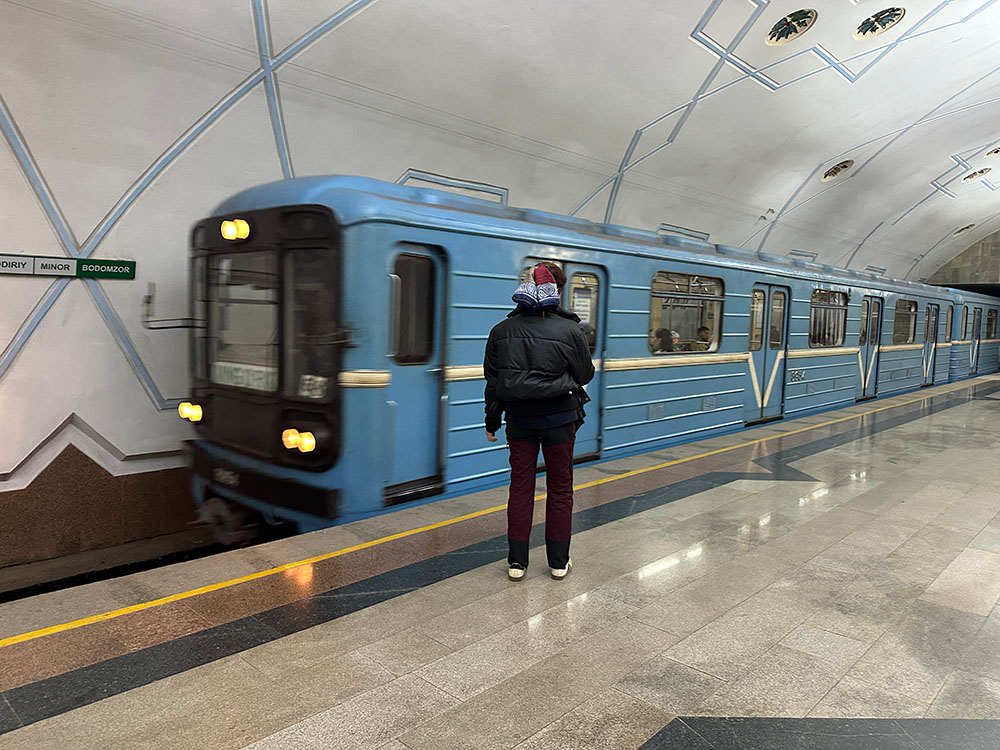
Bodomzor Metro Station: Futuristic Take on Timurid Architecture
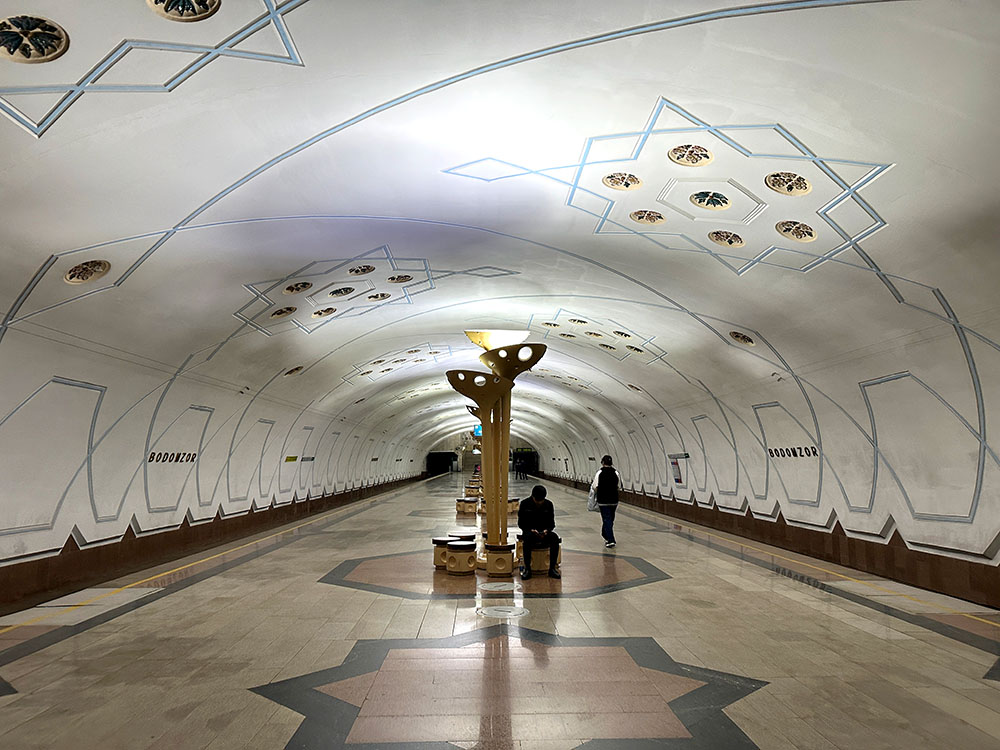
Bodomzor Station is one of the newer stations built in 2001 on the green Yunusobod Line. It has a very futuristic look with rounded curve lamps lighting the station from the ground, but the ceiling features geometric shapes reminiscent of the carvings you see in old Uzbek buildings but rendered in a more modern way. It has a bit of an art deco feel to it.
Bodomzor Station is quite close to the Tashkent TV Tower and the Besh Qozon outlet where we had my birthday dinner (more on that below).
Explore Chorsu Bazaar: The Best Market in Tashkent
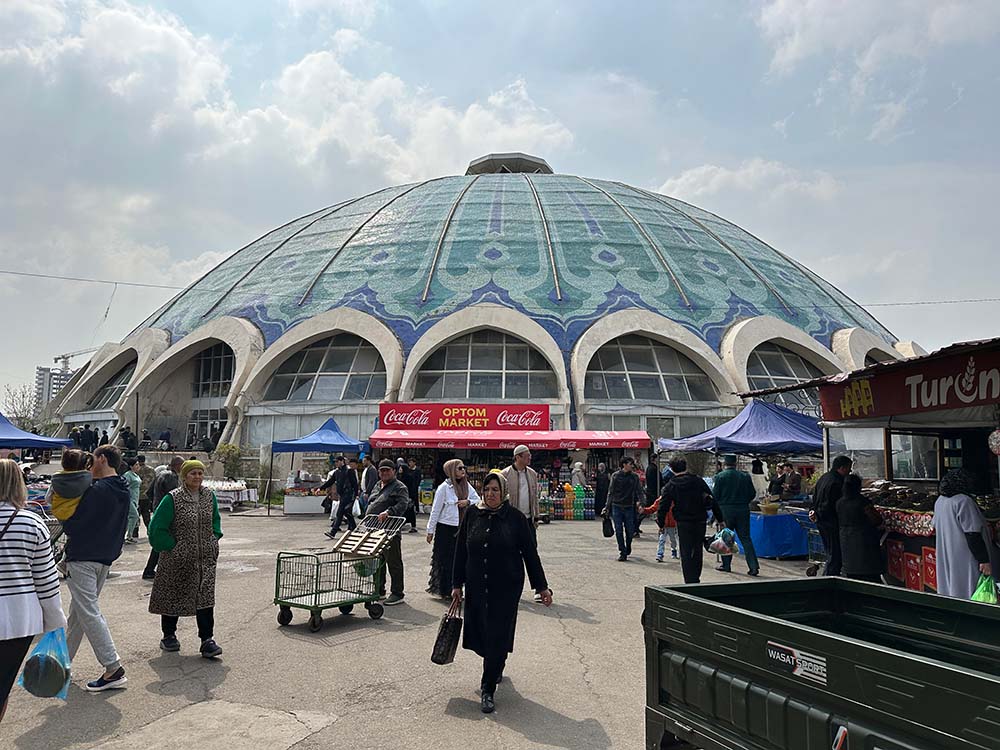
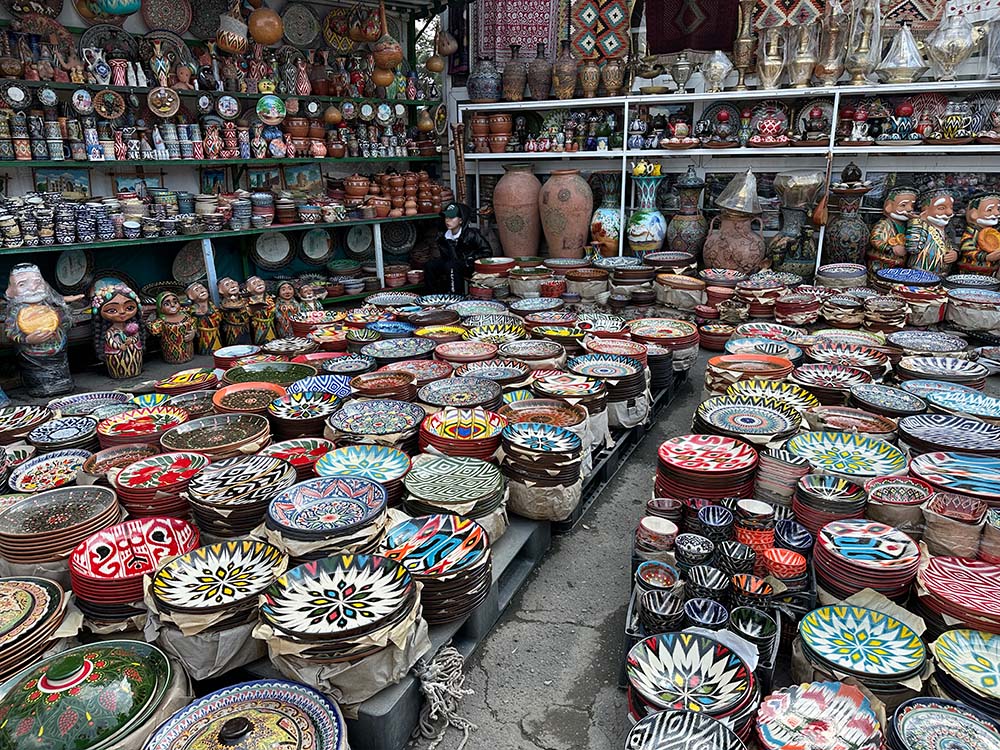
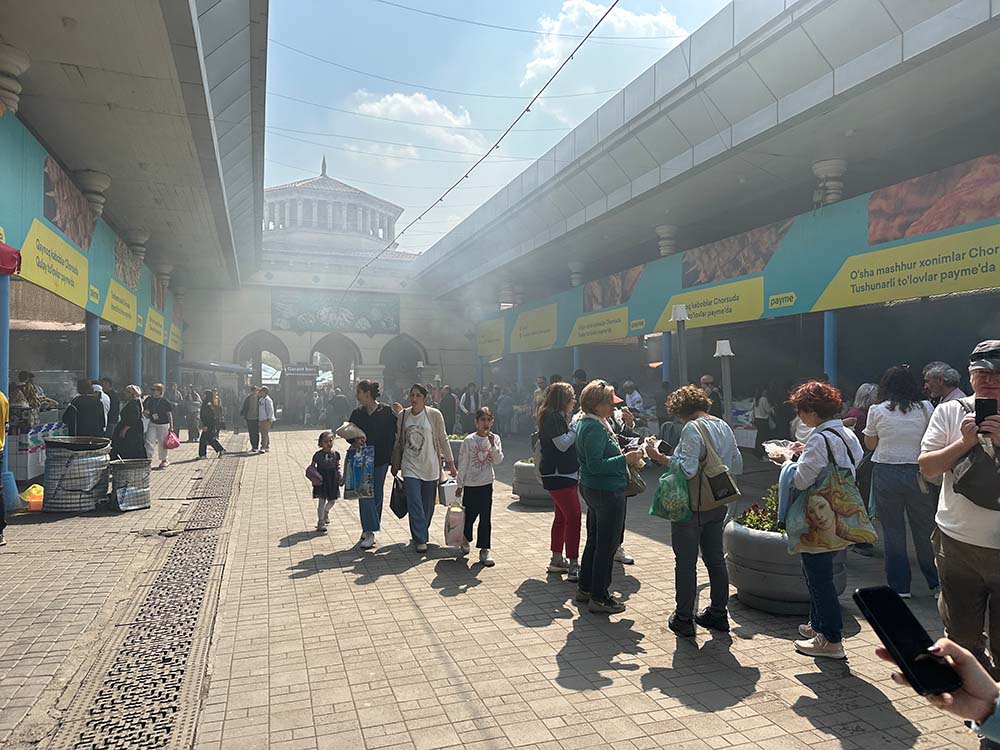
Another favourite place we ended up spending a lot of time in Tashkent was the Chorsu Bazaar. One of the oldest markets in Central Asia, Chorsu Bazaar is a sprawling market place with various levels and indoor + outdoor spaces. The centre of the market is marked by a pretty blue dome with a beautiful geometric interior ceiling. and stalls radiating out from the centre.
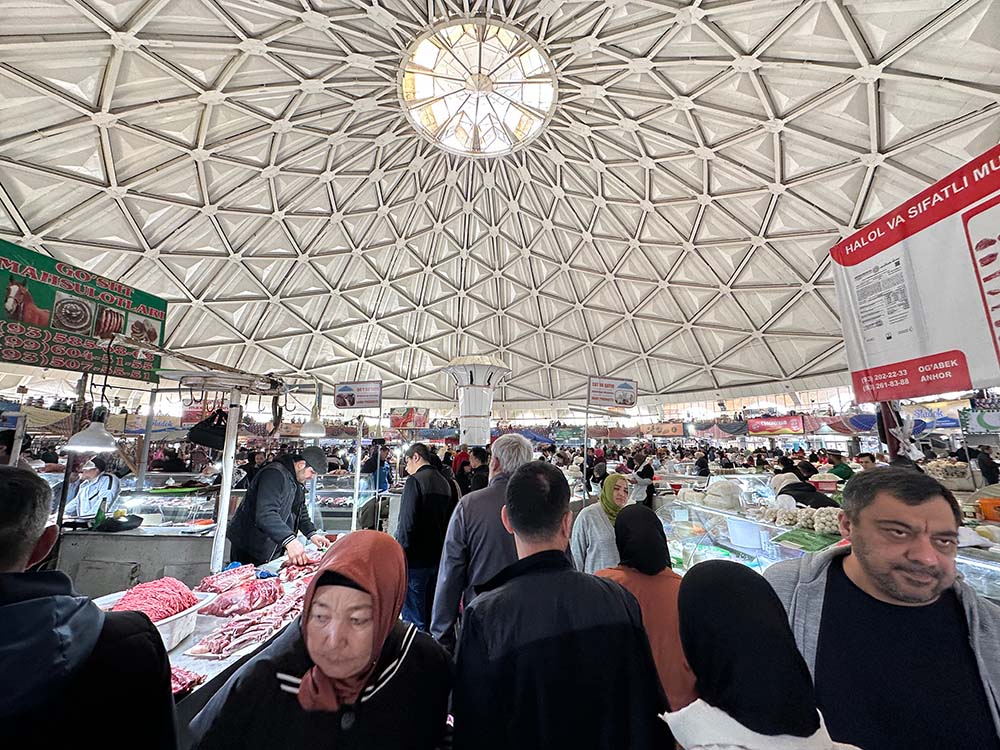
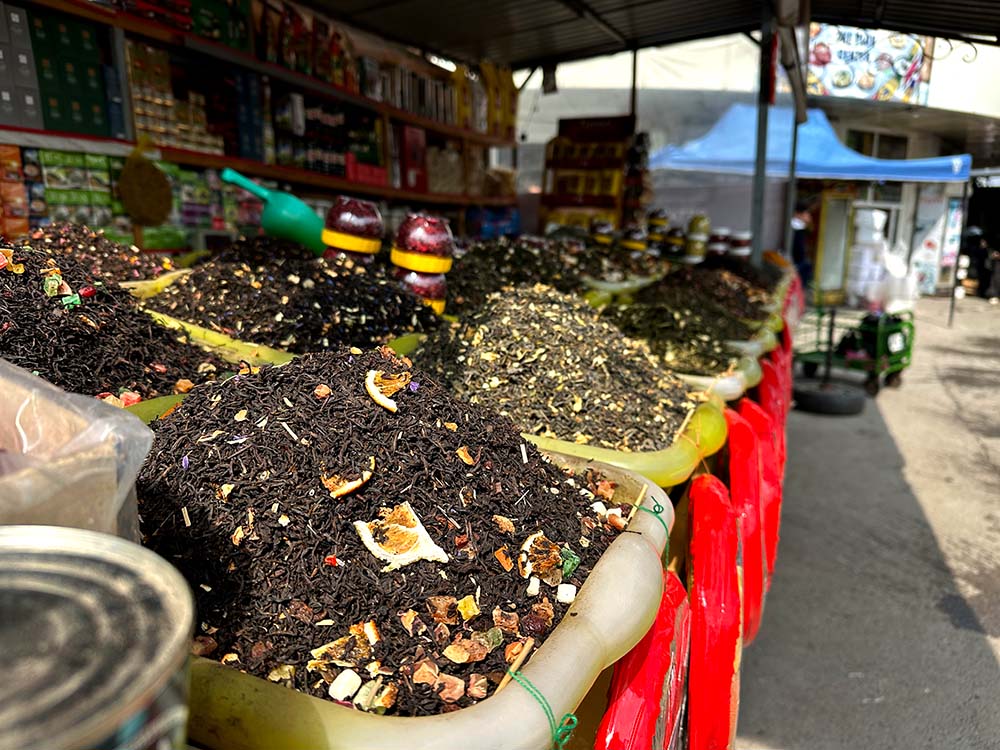
It’s the best place to buy souvenirs – I hit the tea shops and bought lots of fresh tea here – 600gm for just S$2 and it tasted so good! This is how I developed a taste for cold brew tea. You can buy just about any sort of fresh food and produce here at Chorsu Bazaar.
You can also find lots of Uzbek favourite foods in the cooked food alleys, lined with stalls freshly grilling kebabs, horse meat and more! It’s a bit smokey but so much fun. There are tables and chairs to sit down in behind the stalls – we just picked a random stall to sit down at, most of the offerings look quite similar.
We had the prerequisite bread and some kebabs, but also decided to be adventurous and try some horse meat. It’s not my first time eating horse meat – they serve up horse meat sashimi in Japan’s Matsumoto – but here they have something called norin, aka shredded horse meat and hand-pulled noodles are mixed together in a cold pasta dish of sorts. It basically tastes like gamier tougher beef.
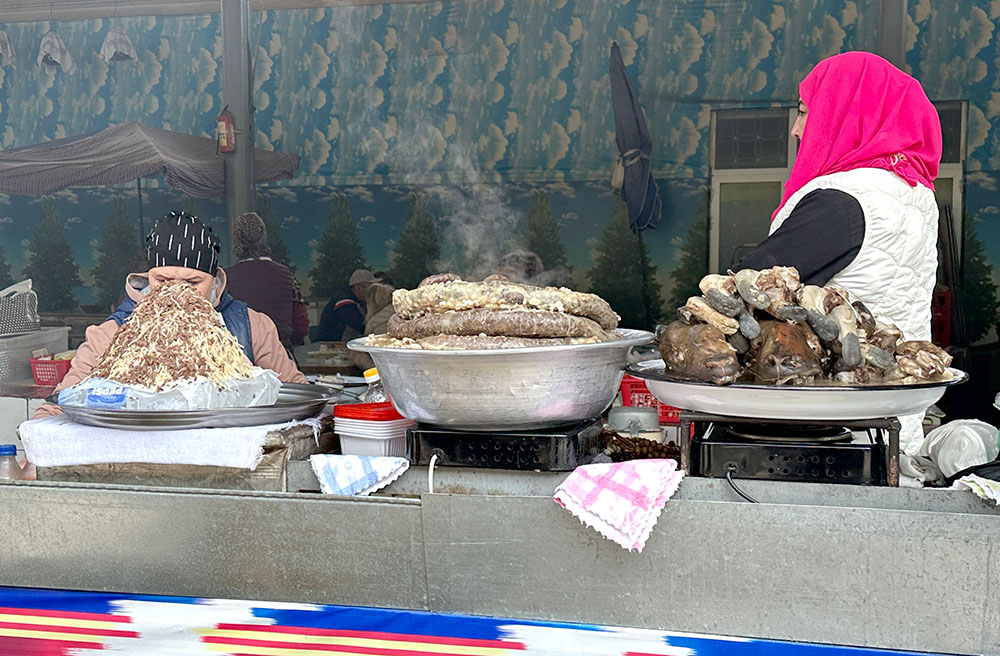
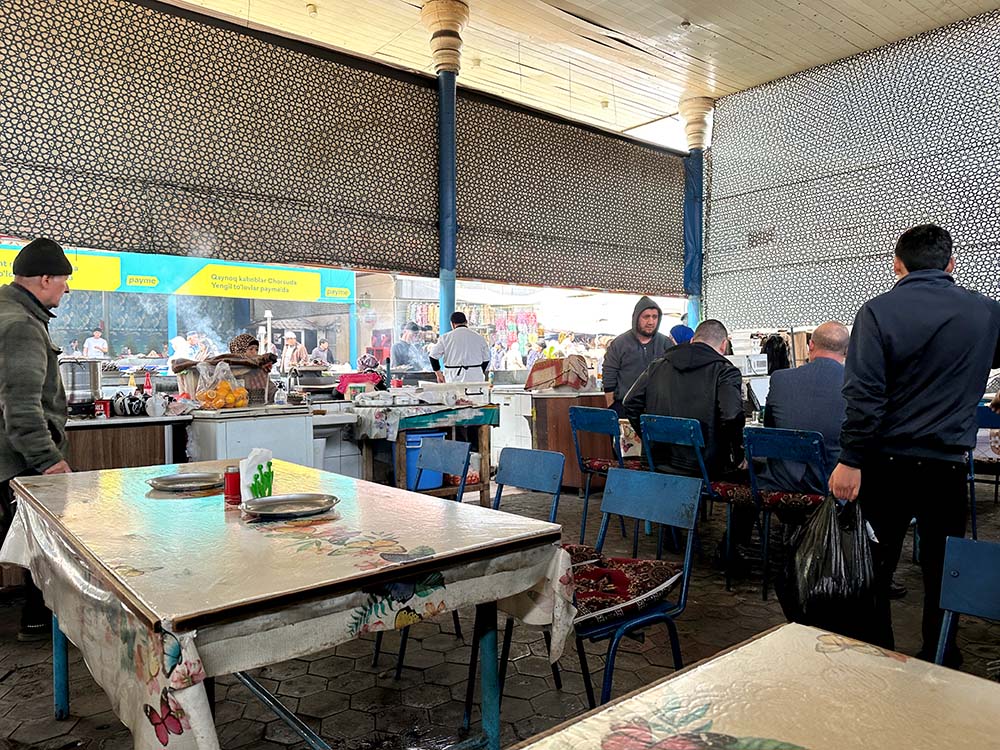
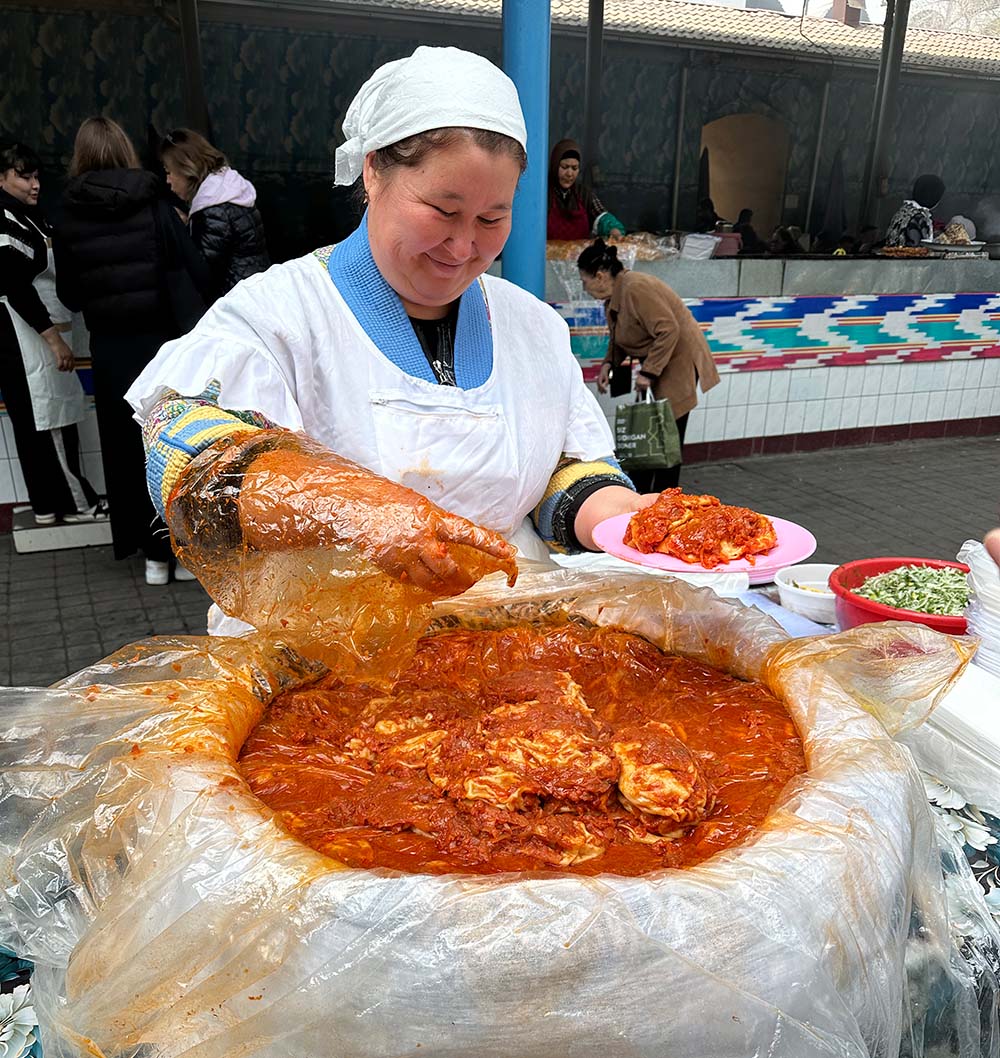
Here was also where we tried honym. It really doesn’t look that appetising from afar, but it’s basically like a lasagna of sorts with potato strips layered in potato dough and doused in a tomato based sauce. Super yummy!
Dinner at Beshqozon: Eat Plov, Uzbekistan’s National Rice Dish
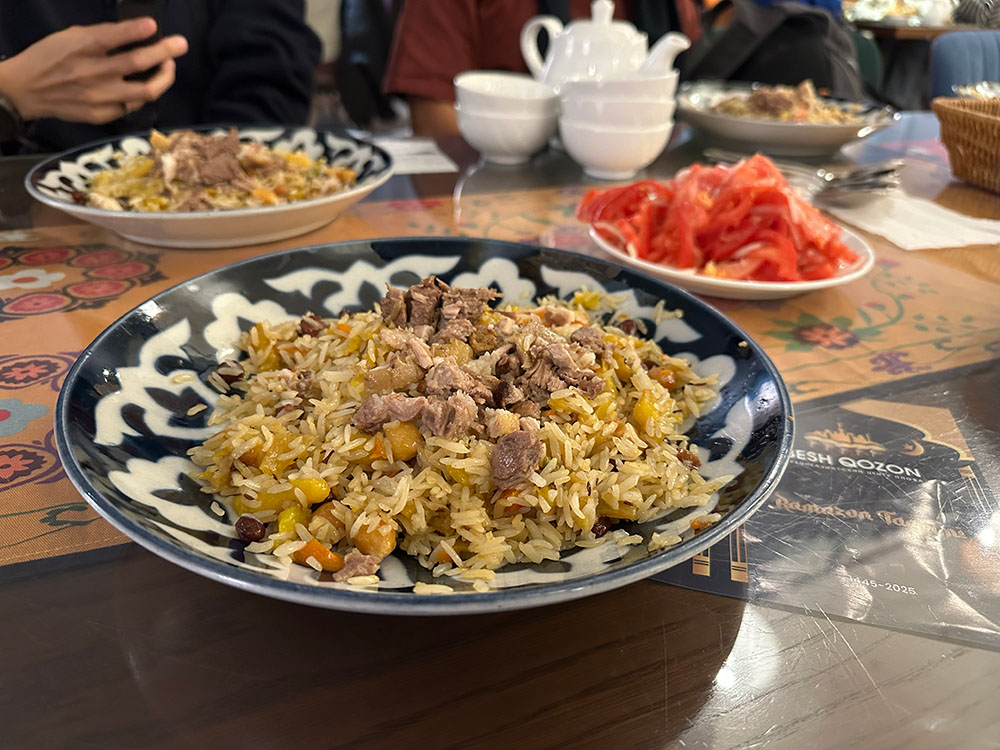
It was my birthday in Tashkent! To celebrate, we headed out to Besh Qozon for dinner and to indulge in what’s pretty much the Uzbek national dish: Plov or pilaf. What’s special about the plov at Besh Qozon is that they cook it in these HUGE woks, and they’re practically using shovels to toss and cook the rice and beef, and you get to watch them do it in the outdoor area.
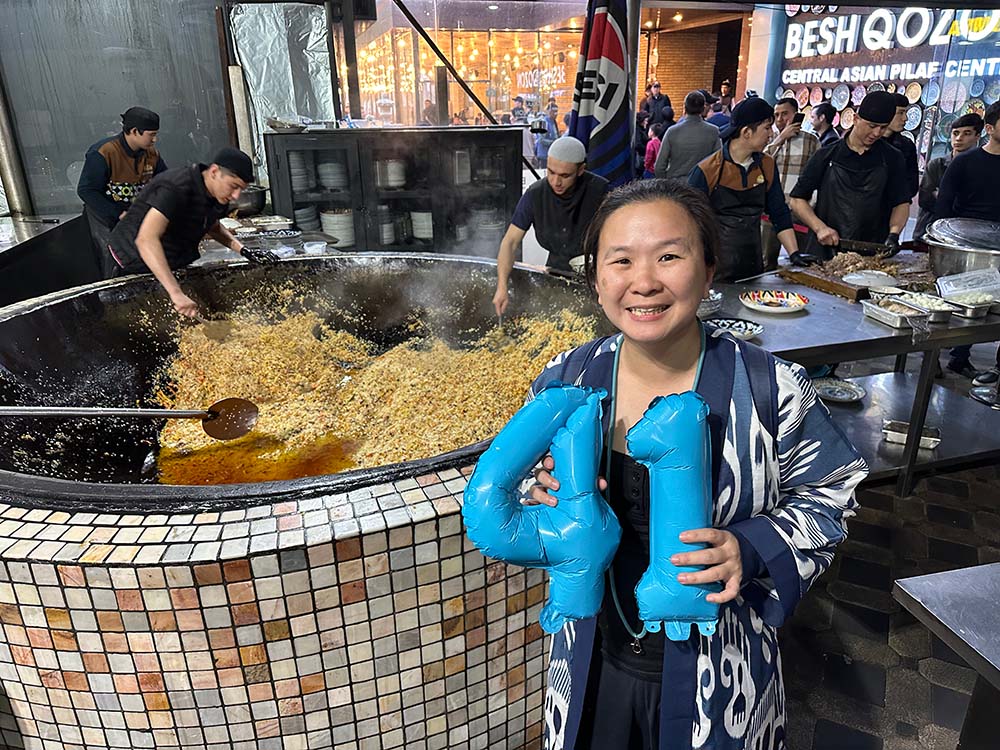
We sat down in the indoor restaurant area and the good thing is that the menu is actually pretty straightforward. Plov, whether a full plate portion or a 0.7 or 70% portion – I had a 0.7 and still couldn’t finish it so I guess I managed a 0.6 in total.
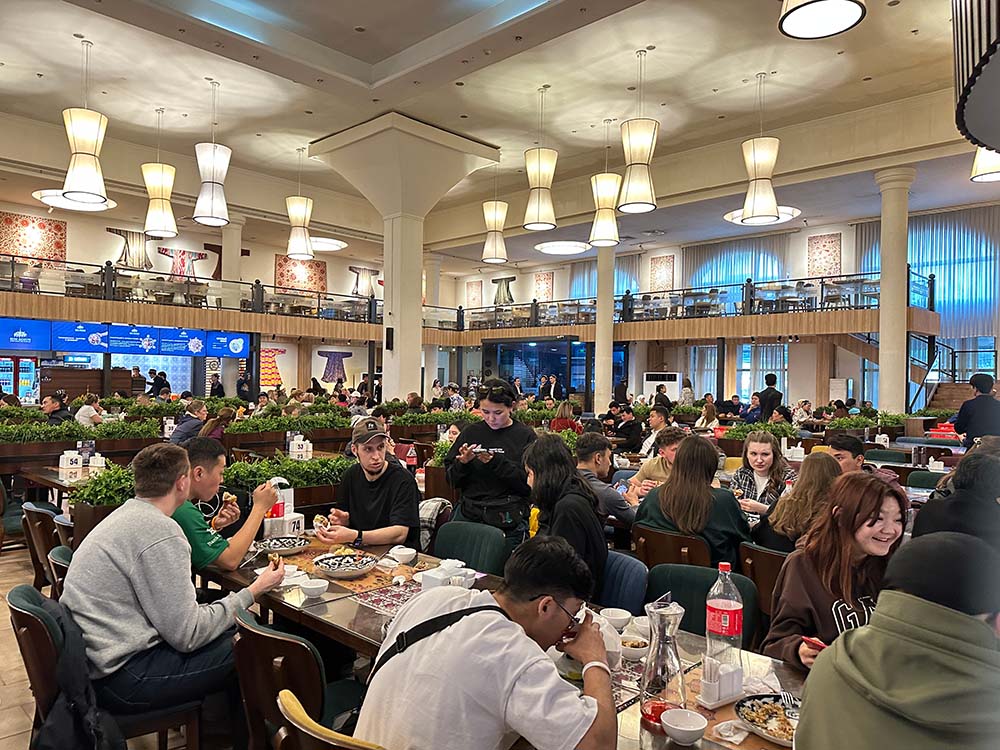
Besh Qozon – there are several outlets, we went to the Yunusabad branch near the Tashkent TV Tower, in between Shahriston and Bodomzor metro stations [Google maps]
Visit Hazrati Imam Complex: Hints of Tashkent’s Heritage
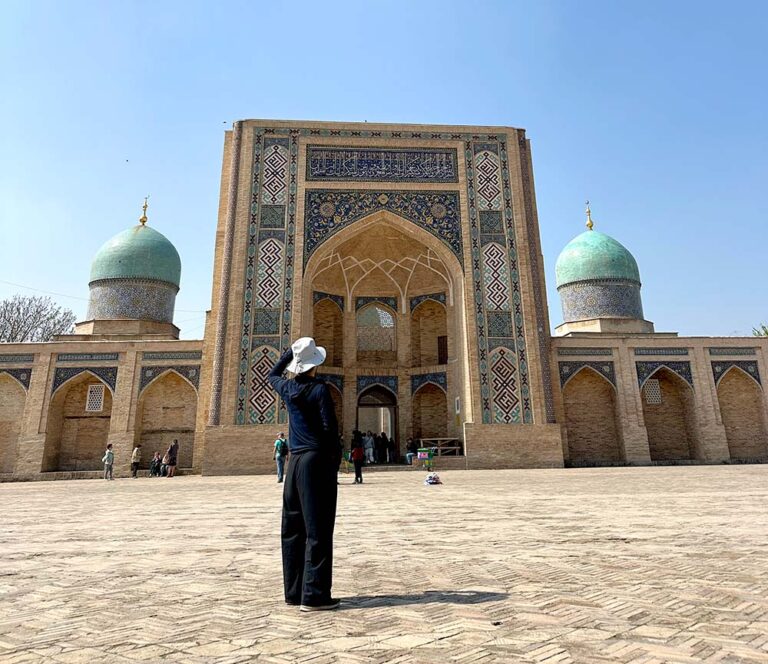
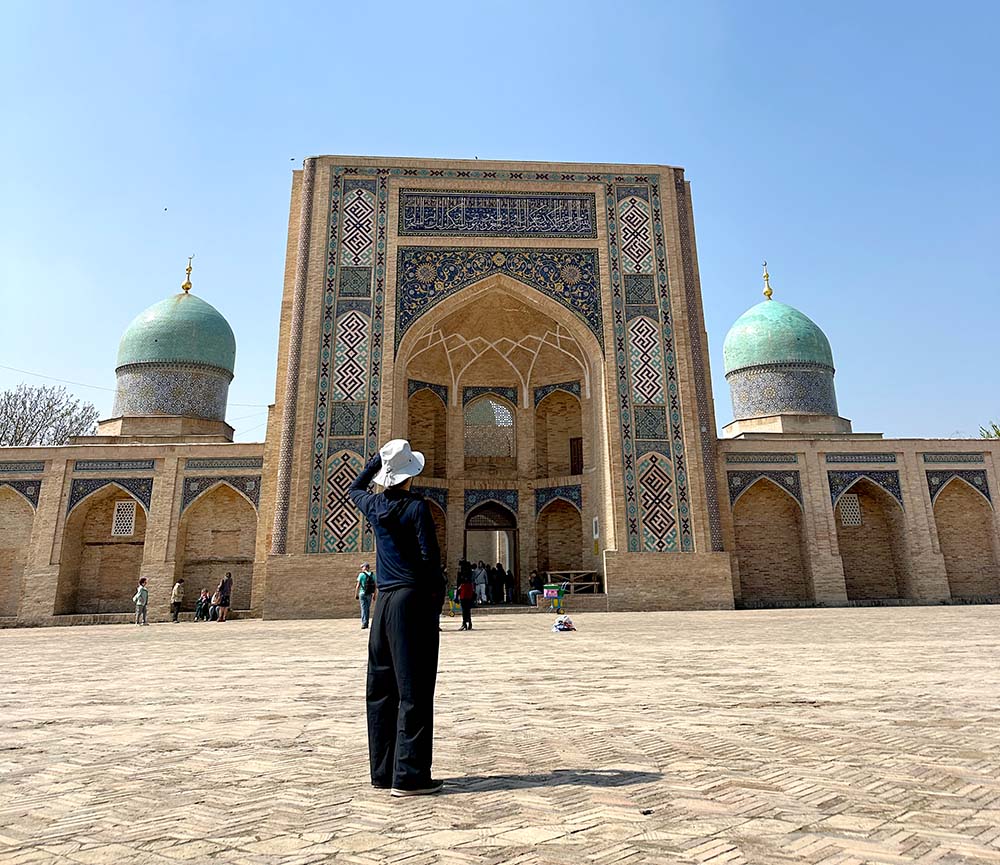
Not many old buildings are left in Tashkent after the earthquake, but the Hazrati Imam Complex or Khast Imam Complex is one of those few places that survived the quake, with history dating back to the 16th century. Named for Tashkent’s first Imam-Khatib – this guy was a scholar, spiritual leader and artist all in one.
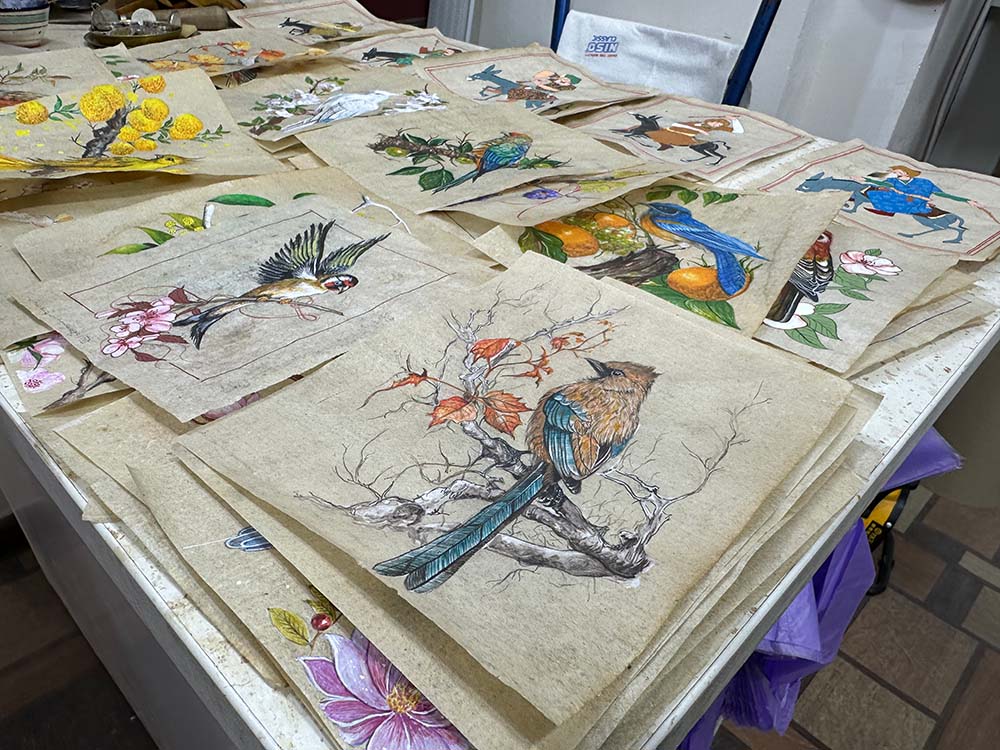
There are several monuments here – we didn’t bother going into everyone but we did go into the Barak Khan Madrasah which is now like many of the old buildings, a craft centre of sorts with many little shops selling souvenirs.
Watch a Performance at the Alisher Navoi Theatre
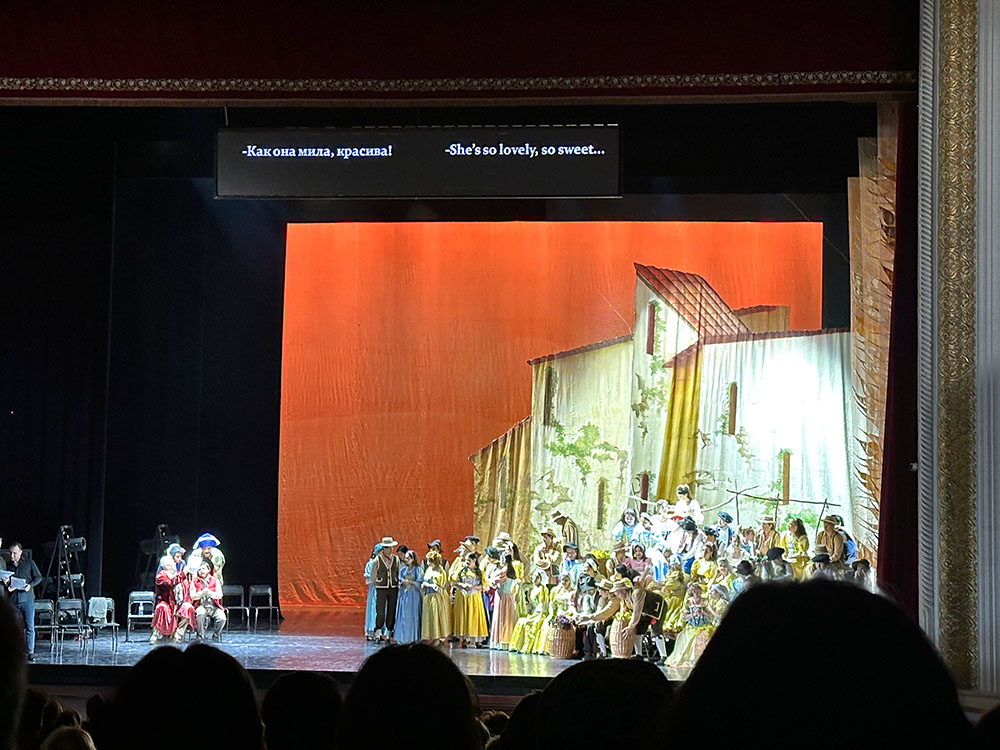
One of the odder things we did in Tashkent was head to the Alisher Navoi Theatre to watch an Italian opera. We happened to be there during Nowruz aka their New Year, and some of the city celebrations included providing free arts performances for everyone to attend. Our tour guide from the Solar Furnace forwarded us a list, and we decided to pop by just to see what it was like.
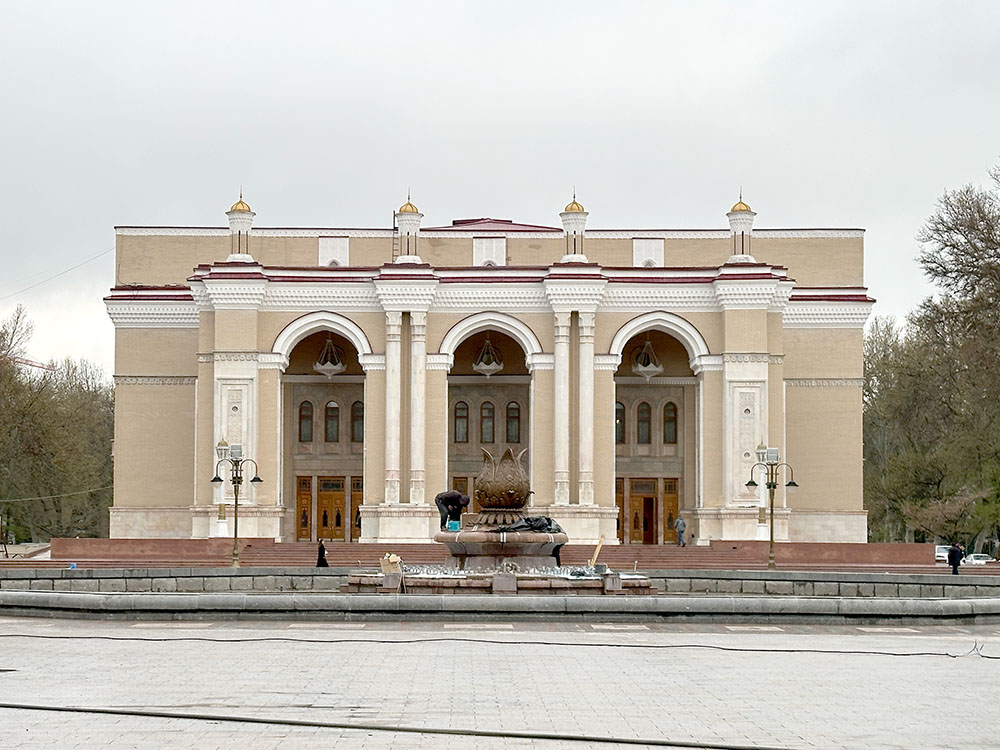
The Alisher Navoi theatre is the state’s National theatre, built in the 1940s and named after a famous Uzbek poet to commemorate his 500th birth anniversary. It’s a really beautiful lavish interior, not unlike the old opera theatres I’ve seen in Europe with lots of gilding and chandeliers. We piled in and managed to find some decent seats to the back of the stalls.
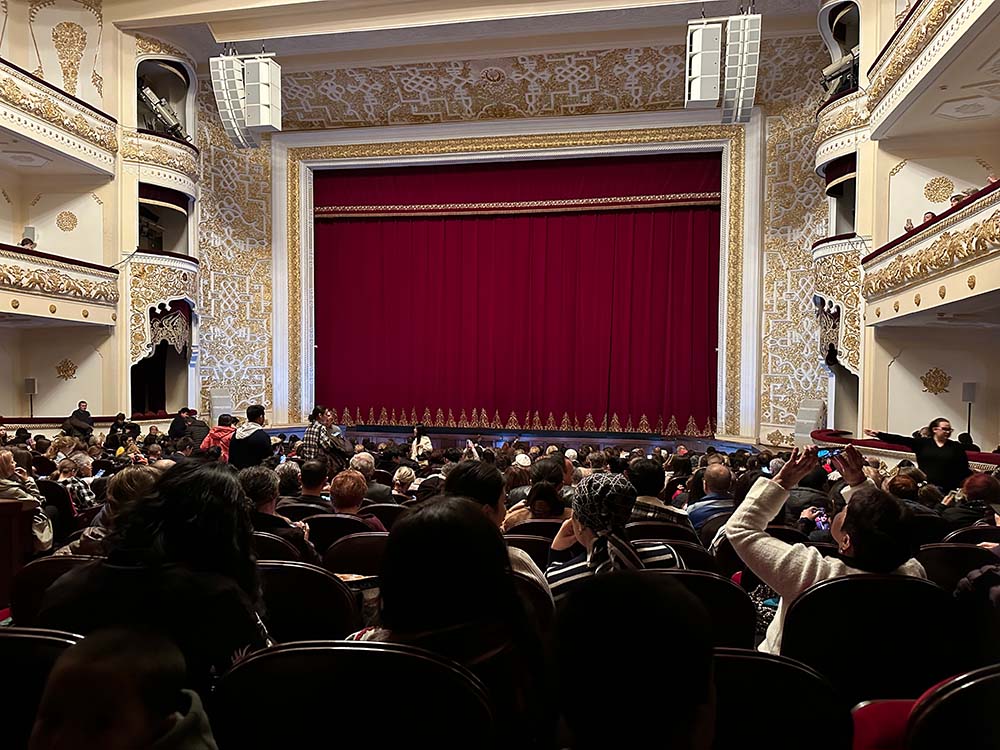
I don’t know if it’s because it’s a free performance or just looser restrictions in general, but generally people were filming and taking photos during the show. The opera we watched was a classic: The Elixir of Love or L’elisir d’amore, wherein a guy tries to get a woman to fall in love with him by drinking an elixir provided by a quack doctor. Luckily they had surtitles in Uzbek and English so we could understand the programme.
It had been a long day though, so we ended up only watching the first half and ducking out at the intermission, oops.
Stroll Tashkent City Mall: Modern City Conveniences
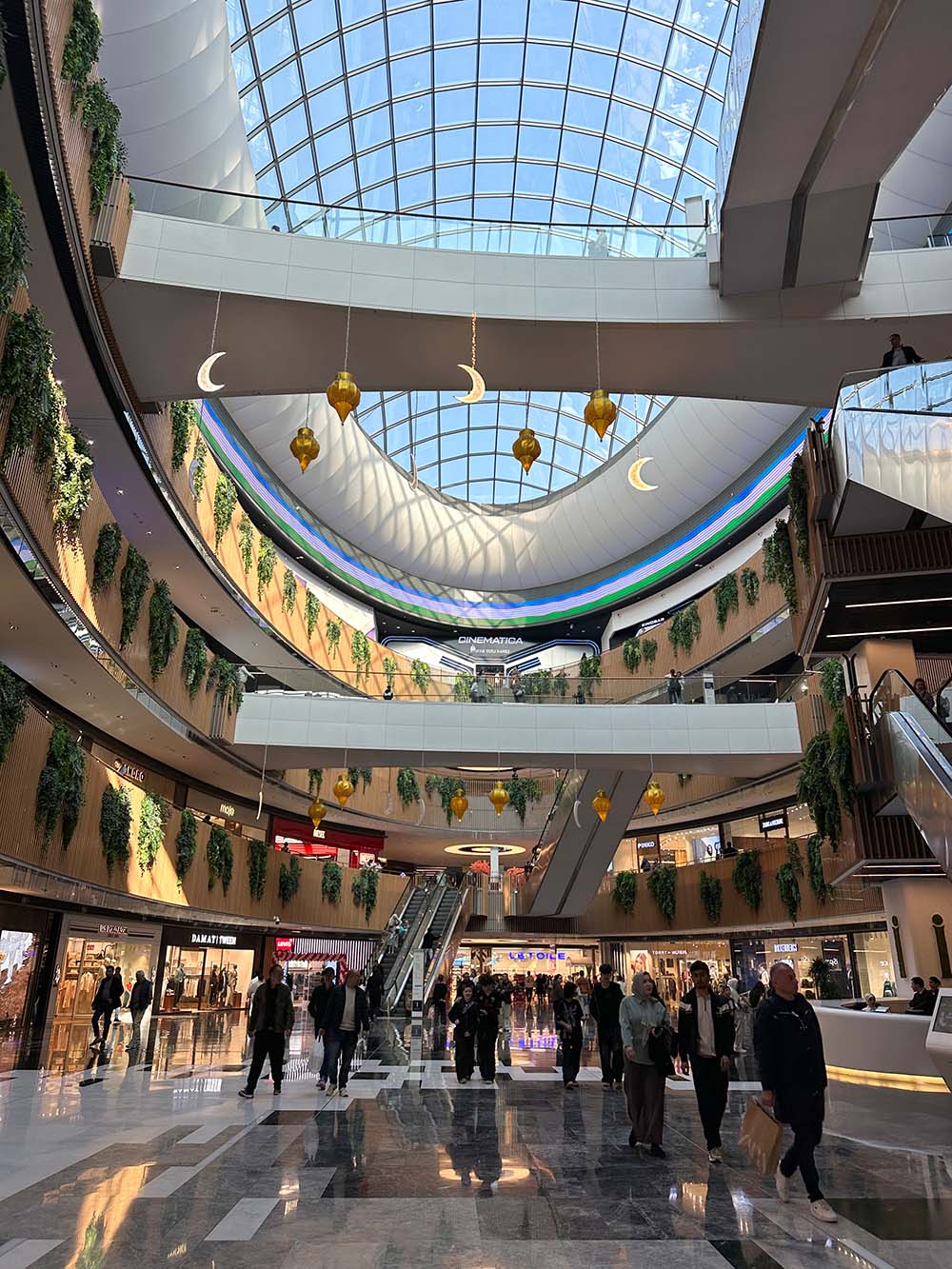
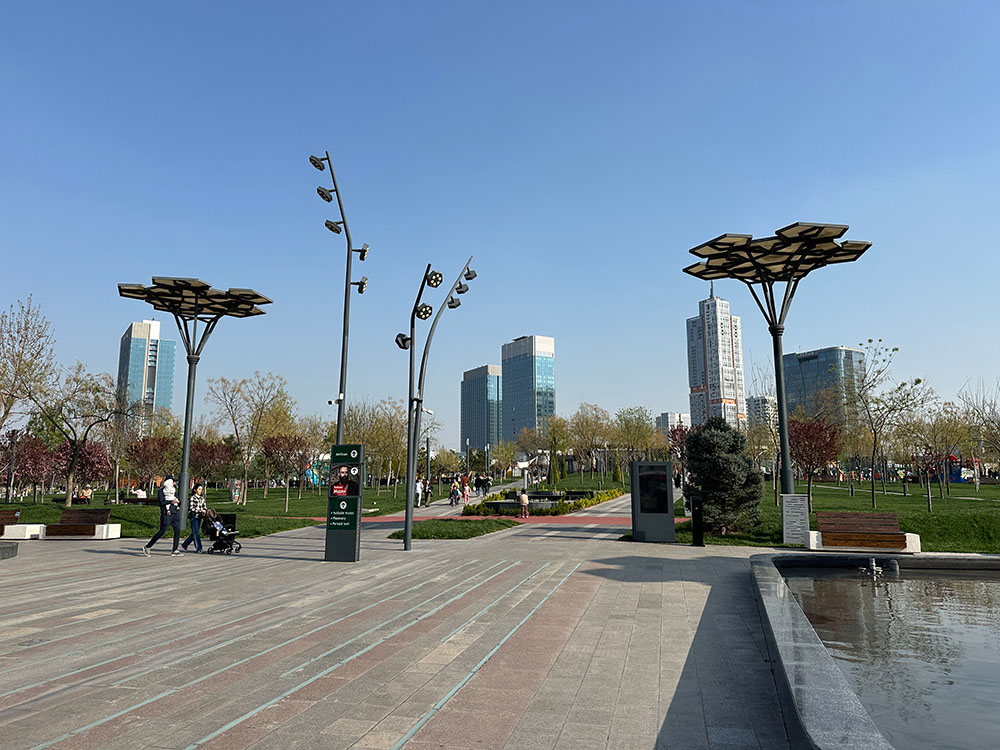
On our last evening in Tashkent, we had some time to kill before catching our flight in the evening. We had mostly done all the sightseeing we wanted to at this point, so we ended up spending a few hours at the modern Tashkent City Mall for dinner and just to chill out.
This could be any modern mall in Singapore or anywhere in the world where you can find major international brands, restaurants and other amenities, so nothing to shout out, but it was a nice change after all the historical buildings we’d seen over the last 2 weeks.
Tashkent Day Trip: Tour the Uzbekistan Solar Furnace in Parkent
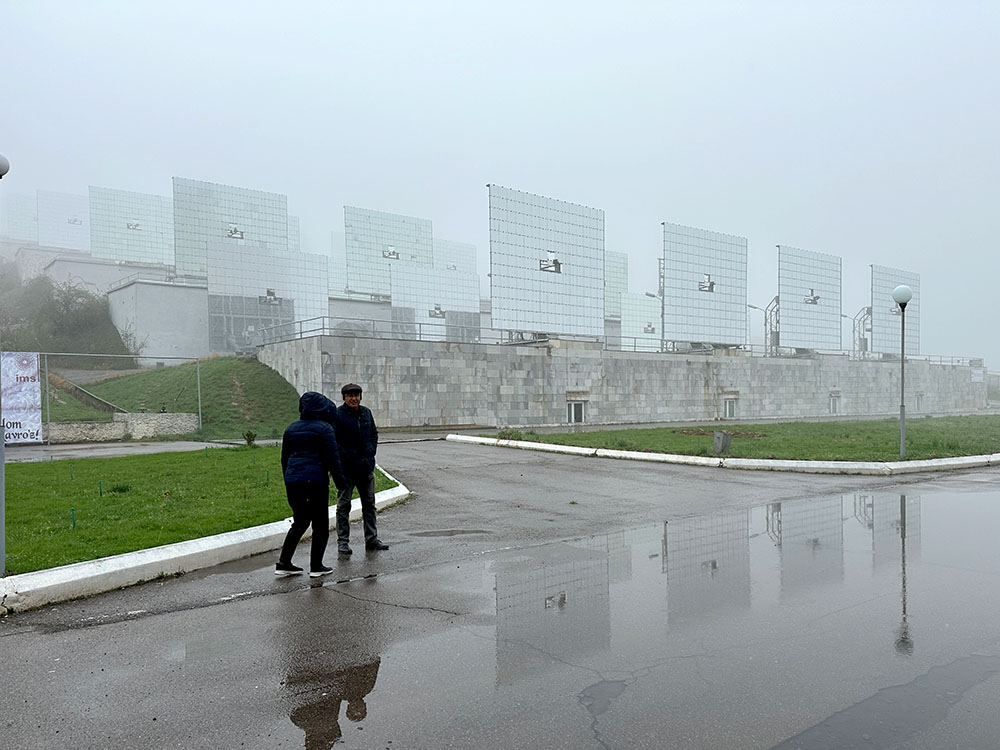
One of my favourite weird things we did in Tashkent was take a day trip to see the Uzbekistan Solar Furnace. Located in the Parkent mountain range about an hour outside of downtown Tashkent, the Uzbekistan solar furnace is a facility built in the 1980s for research and experiments in utilising solar energy. That Soviet facility collapsed along with the USSR but was reopened in 1993 on a much smaller scale. The solar furnace is one of two, just slightly smaller than the one in Odeillo, France.
Now Parkent was chosen for the solar furnace because apparently this mountain range sees a lot of sun throughout the year, but of course the one day we isit isn’t just a non-sunny day, but it was actively COLD and even snows at one point, so unfortunately we weren’t able to see some of the practical demonstrations but we still got to see the cool set up.
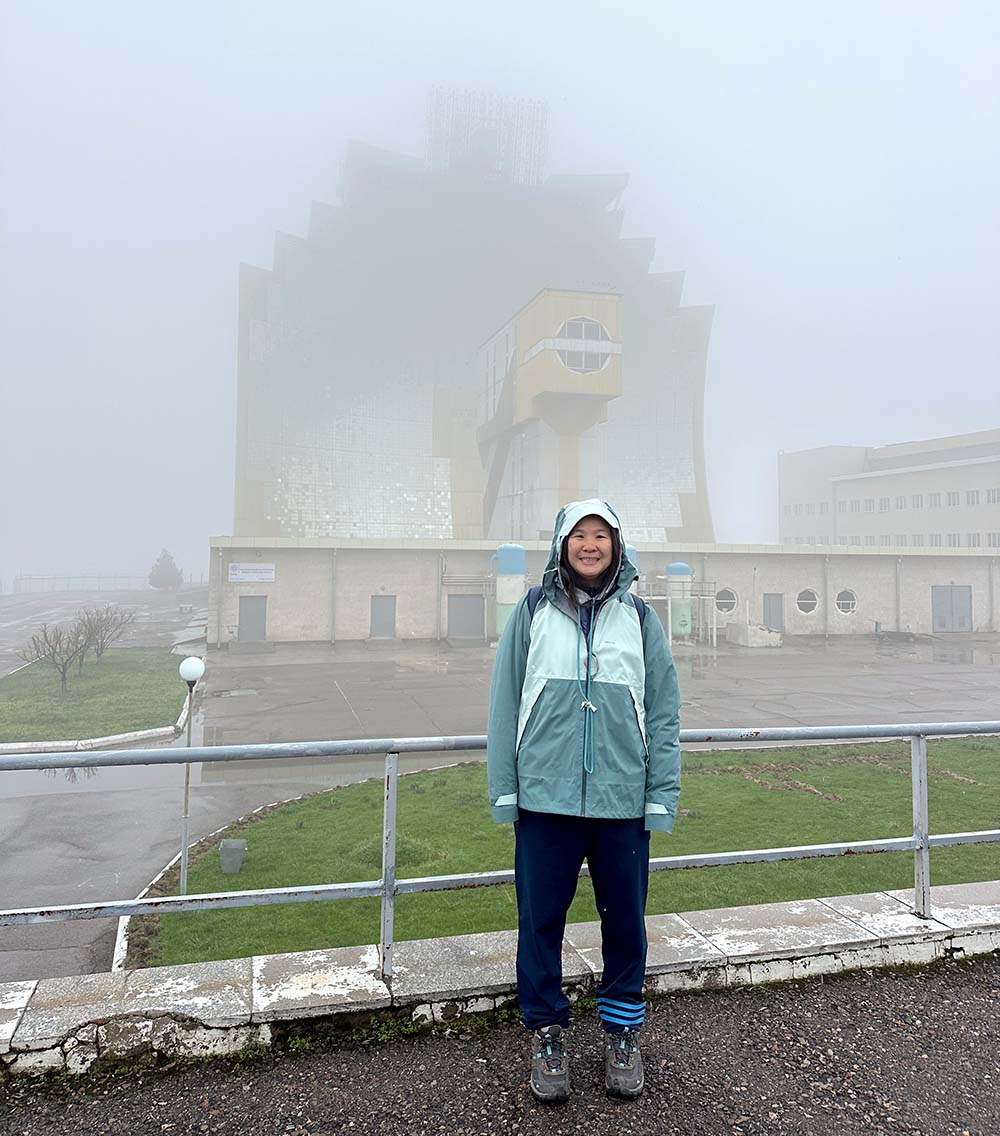
The facility was a bit old and things were kinda all over the place, like they were in the midst of moving things around but never quite finished. This was a guided tour with transport arranged from Tashkent, and we had an engineer who worked at the solar furnace. We started in the indoor area where there were some very basic printed panels around that he used to explain some concepts, as well as some simple demo stations. Solar research was also used to create carbon fibres as well as insulating material.
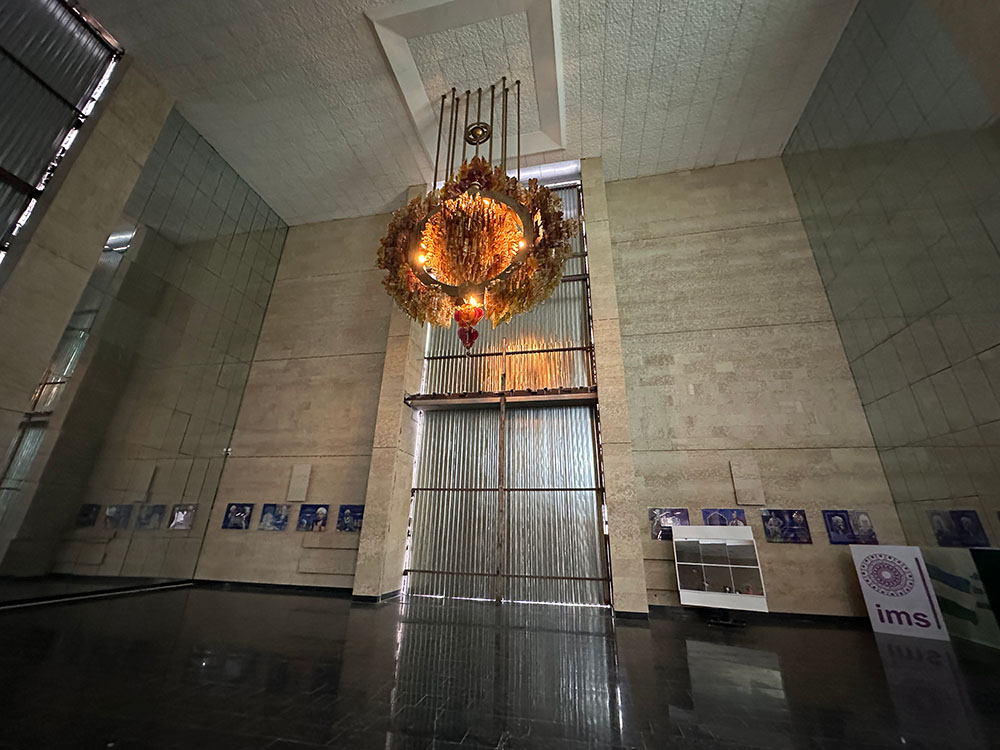
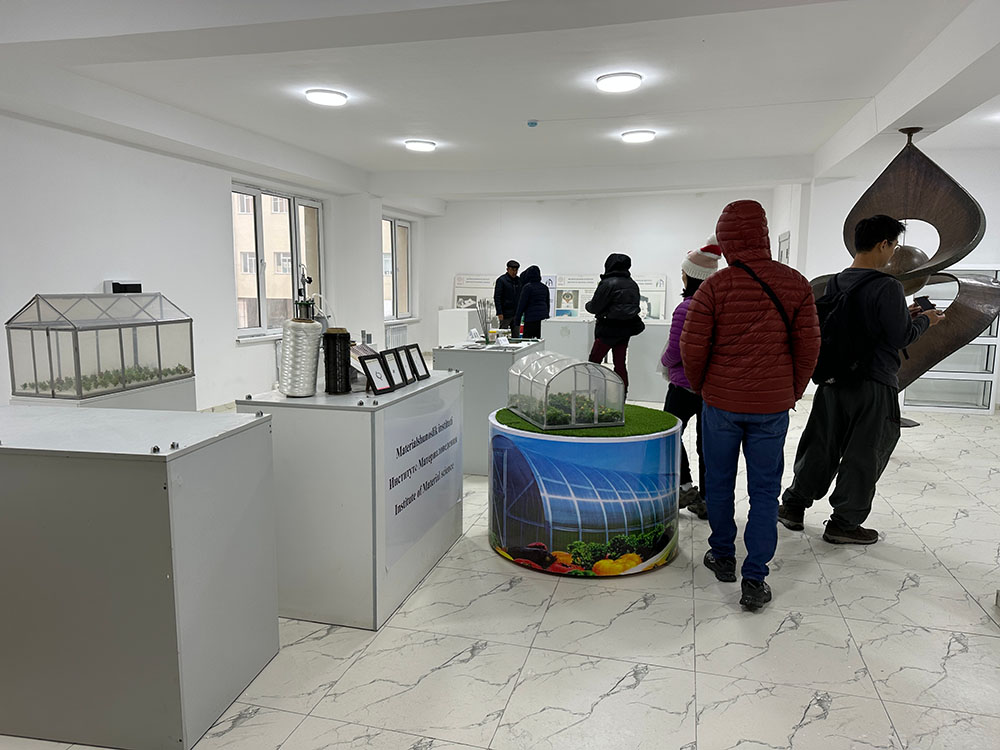
While it is a science and research facility, it’s not particularly high tech looking. We headed outdoors which is the most interesting part of the solar furnace because of the 62 heliostats standing tall. These are basically made up of a bunch of little mirrors that reflect the sunlight into a large concentrator which focuses all that sunlight. That combined heat reaches astronomical temperatures up to 3000ºC!
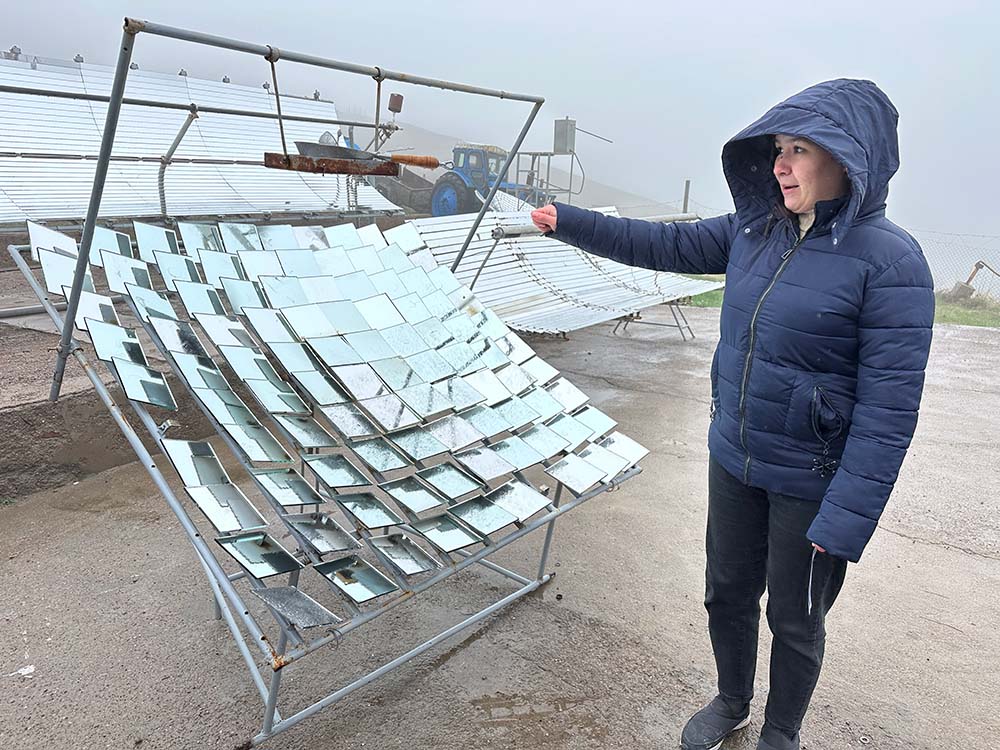
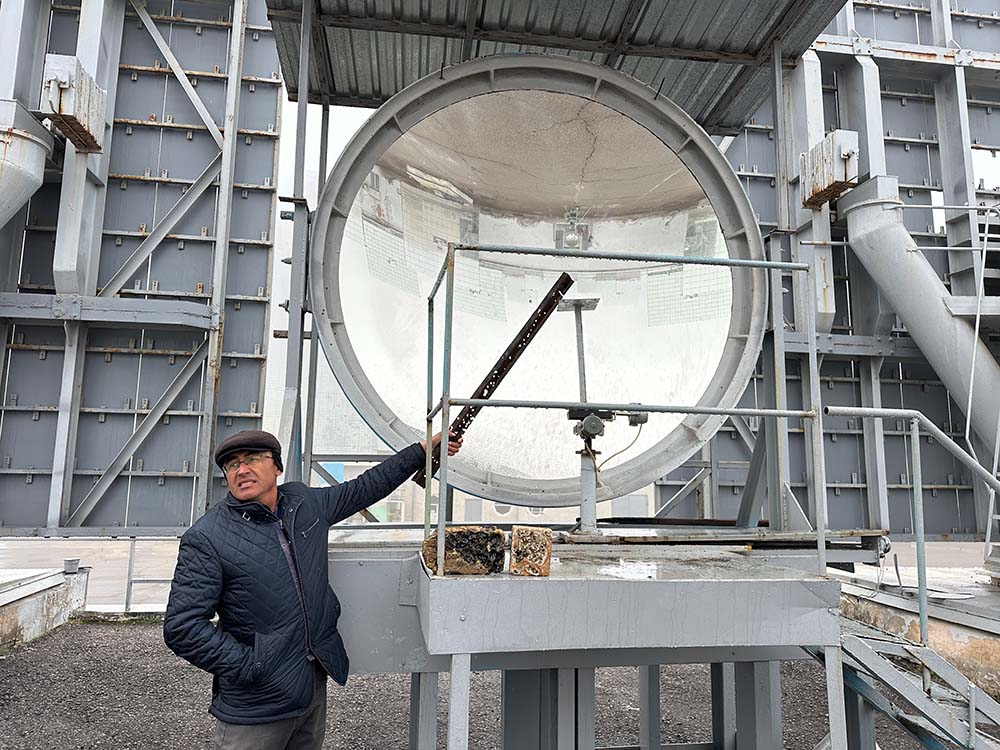
Because there wasn’t any sun, we weren’t able to see the solar heat effects, so we mostly spent it taking hilarious photos withe the concave mirrors. It was an interesting day out, especially compared to all the madrasahs and markets that we’d been seeing so far.
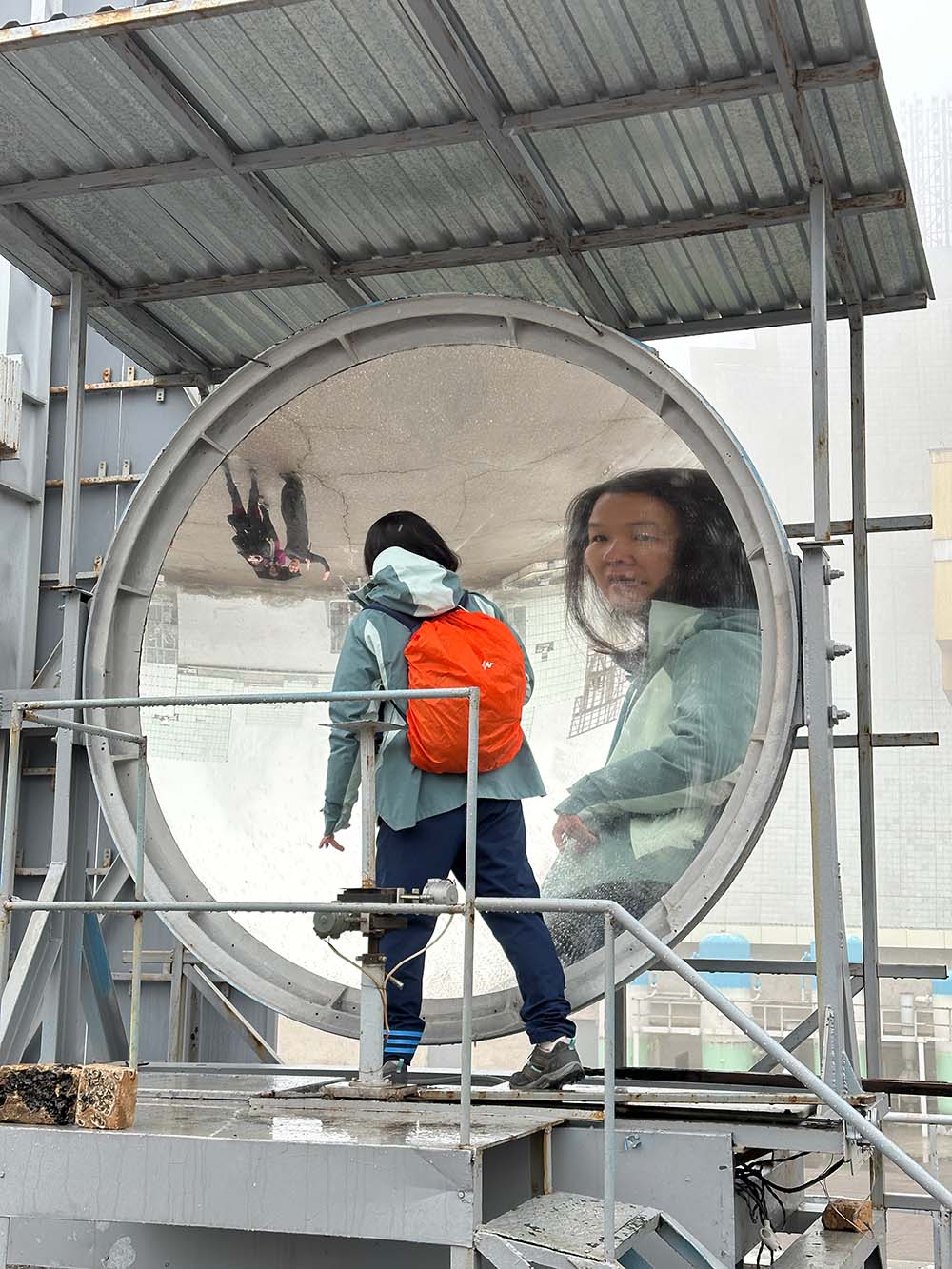
We booked the trip to the solar furnace with Let’s Trip that included a bilingual English speaking guide, round trip transport from Tashkent to Parkent, and a stop for lunch in the village of Sukok.
Where to stay in Tashkent: Hotel 1946
In Tashkent we stayed at Hotel 1946. We could walk to Chorsu Bazaar, Alisher Navoi Metro Station and Tashkent City Mall in about 20 minutes, but there’s not that much around the hotel itself as it’s along quite a major road that’s almost a highway. The hotel itself was quite decent with clean simple rooms.
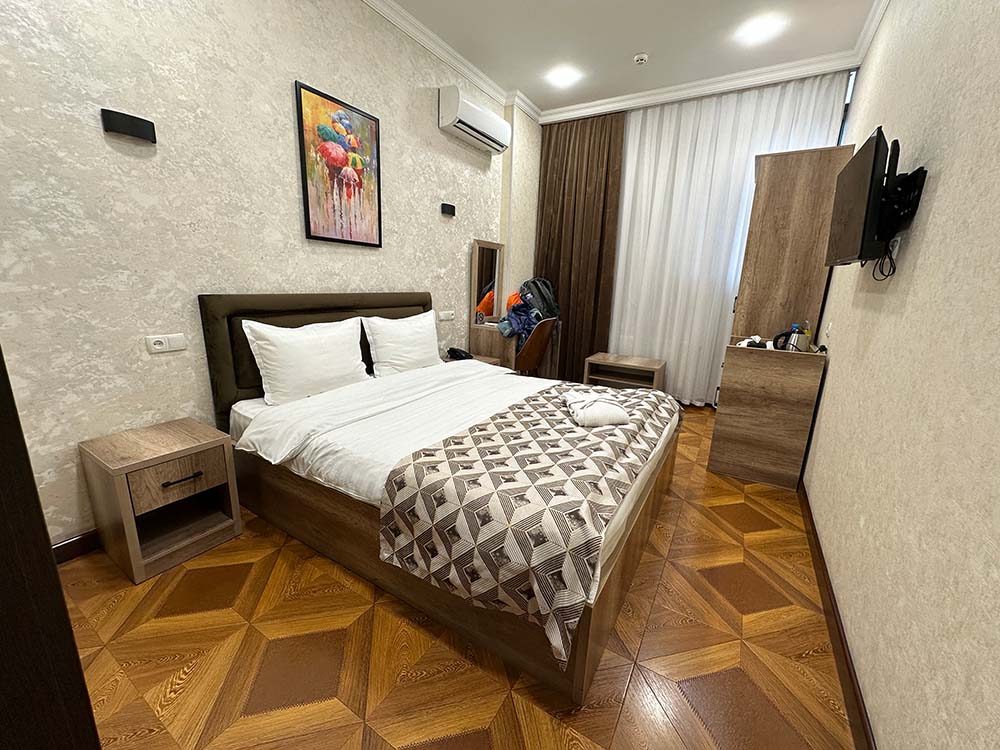
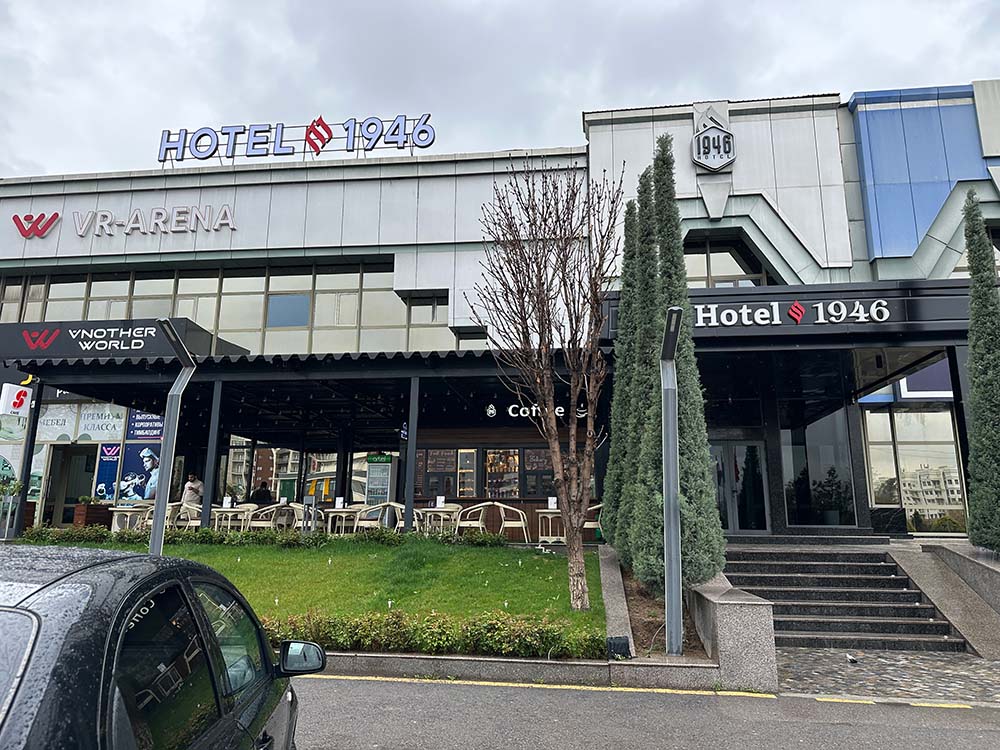
Check out Hotel 1946 on booking.com [affiliate link]
Have you visited Uzbekistan’s capital city of Tashkent? Share what you did here, or check out my other posts from my Uzbekistan trip.